The monkeys
The three wise monkeys at Nikko: one panel of eight
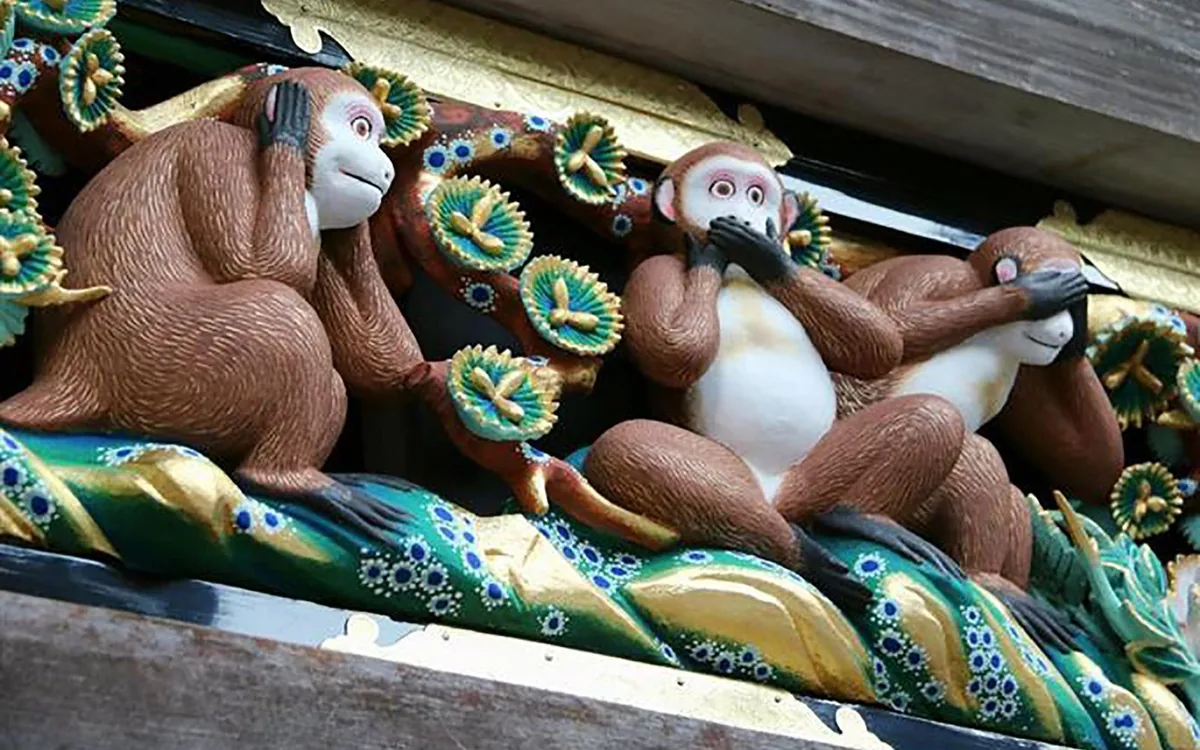
See no evil, hear no evil, speak no evil is a phrase that came to English from a carved panel on a stable in a Japanese mountain town, and almost everybody who visits it photographs that one panel and walks straight past the other seven that finish the story.
Quick answer
The three wise monkeys are carved on the sacred stable at Nikko Toshogu, and they form the second of eight panels telling a life from childhood to parenthood. The carving dates from the 1630s rebuilding and predates the English phrase by centuries. It is included on every tour on this page, and most visitors spend two minutes on it and none on the rest.
The monkeys, at a glance
- Where
- The sacred stableat Toshogu, before the Yomeimon gate
- How many panels
- Eightthe monkeys are the second
- What the sequence shows
- A lifefrom childhood to parenthood
- Date
- 1630sin Iemitsu’s rebuilding
- Why a stable?
- Monkeys guard horsesa long-standing belief in Japan
- The English phrase
- Came laterthe carving is the older thing
- Size
- Smallsmaller than every photograph suggests
- Crowd
- Constantthis is the busiest ten metres at Toshogu
- Included on
- Every tour hereentry to Toshogu is in the price
- Tours from
- $66ten hours from Tokyo
The whole sequence
What do the eight monkey panels actually show?
Eight panels, a whole life, and the famous one is the second.
A life, in order, and it is a much better thing than the fragment everybody knows.
The panels run along the sacred stable and follow a monkey from infancy to adulthood. In the first a mother looks out at her child’s future. In the second — the famous one — three young monkeys cover eyes, ears and mouth, which in the sequence reads as a lesson to the young: do not look at, listen to or say what is bad.
The panels that follow show the monkey sitting alone, looking up at ambition, being comforted by a friend, falling in love, facing the world with a companion, and finally expecting a child of its own — at which point the sequence returns to where it started.
It is a cycle rather than a story with an ending, and the three wise monkeys are one moment inside it rather than a standalone proverb. Knowing that changes the ten metres of wall from a photo stop into the most human thing at a site otherwise devoted to power.
Why a stable
Five things worth knowing about the carving
Small, and every one of them makes the crowd around it more bearable.
- Monkeys were believed to protect horses
Which is why the panels are on the sacred stable rather than anywhere more prominent. The stable held the shrine’s white horse.
- The carving predates the English phrase
“See no evil, hear no evil, speak no evil” entered English in the nineteenth century, long after these panels were cut.
- It is smaller than you expect
Considerably. Every photograph is a close crop, and the actual panel sits high on a plain wooden building.
- The stable is a plain building on purpose
Unpainted wood, in the middle of the most gilded complex in Japan. The contrast is deliberate.
- The crowd is at its worst here
It is the first famous thing on the route in. Walk past, do the gate, and come back on the way out when the coach groups have moved on.
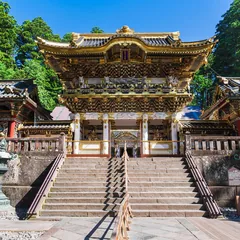
The monkeys are ten metres from the gate that is the real reason to come.
The Yomeimon gate→Every trip, current fare
Every tour that visits the stable
Twelve tours, cheapest first. All of them enter Toshogu, and the monkeys are on the way in.
| Tour | Length | Price | Lake Chuzenji | Cost per hour | Rating |
|---|---|---|---|---|---|
| Private Tour with English-Speaking GuideA private guide at a coach price | 10 h | $66 | If you want it | $6.60 | 5.0 · 45 |
| World Heritage Sites & Hot Spring Day TripThe World Heritage sites and a hot spring | 10 h | $71 | Not included | $7.10 | 5.0 · 1 |
| Kegon Falls, Lake Chuzenji & ToshoguThe most-reviewed Nikko day, lake included | 10.5 h | $74 | Included | $7.05 | 4.6 · 2,272 |
| Toshogu Shrine and Lake Chuzenji Day TripToshogu and the lake, no waterfall stop | 10 h | $75 | Included | $7.50 | 4.4 · 33 |
| Toshogu Shrine and Kegon Waterfall TourThe shrine and the waterfall, most booked | 10.5 h | $83 | Falls only | $7.90 | 4.5 · 1,506 |
| Guided Day Trip to the World Heritage SitesAll three World Heritage sites | 10 h | $88 | Not included | $8.80 | 4.7 · 75 |
| Private Customizable Day Tour with DriverA driver, a vehicle and your own itinerary | 10 h | $303 | If you want it | $30.30 | 5.0 · 26 |
| Full-Day Personal and Private TourA private day, rated 4.9 | 10 h | $311 | If you want it | $31.10 | 4.9 · 316 |
| World Heritage Site Private Day TripA private car and driver | 10 h | $337 | If you want it | $33.70 | 5.0 · 1 |
| Nikko Day Tour with English DriverAn English-speaking driver, flexible route | 10 h | $342 | Included | $34.20 | 4.8 · 23 |
| Private Tour: Toshogu Shrine & Kegon FallsToshogu, the lake and the falls, privately | 10 h | $397 | Included | $39.70 | 4.4 · 11 |
| World Heritage Site Private Full-Day TripThe most complete private day here | 10–11 h | $458 | If you want it | $43.62 | 5.0 · 436 |
Common questions
The three wise monkeys, answered
Where are the three wise monkeys in Japan?
On the sacred stable at Nikko Toshogu, in Tochigi Prefecture, about two hours north of Tokyo. They form one panel of eight carved in the 1630s.
What do the three wise monkeys mean?
In the sequence they are a lesson to the young: see no evil, hear no evil, speak no evil. They are the second of eight panels showing a monkey’s life from childhood to parenthood.
Why are the monkeys on a stable?
Because monkeys were believed in Japan to protect horses, and the building held the shrine’s sacred white horse.
Are the three wise monkeys Japanese?
The carving is, and it is older than the English phrase. The idea has parallels elsewhere, but this panel is the image the phrase became attached to.
How many monkey panels are there at Nikko?
Eight, running along the sacred stable. Most visitors photograph the famous one and miss the other seven.
Go deeper
More on Nikko
Nikko Toshogu
The mausoleum of Ieyasu, and why it is covered in gold.
The dayA day trip from Tokyo
Ten hours, four of them travelling, and what fits into the rest.
Getting thereTokyo to Nikko
Two railways, two hours, and which pass covers what.
All threeThe shrines and temples
Toshogu, Futarasan and Rinnoji, and what UNESCO listed.
The gateThe Yomeimon gate
508 carvings, no two the same, and one column upside down.
The waterfallKegon Falls
Ninety-seven metres out of a lake, and the lift to the base.