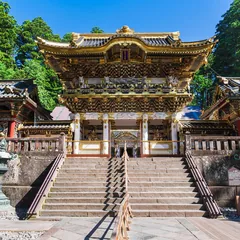
All three
The shrines and temples of Nikko: what UNESCO actually listed
People say “Nikko shrine” and mean Toshogu, which is fair — it is the one on every photograph. But the World Heritage listing covers three separate sites and a hundred and three buildings, and the two nobody mentions are five minutes’ walk from the one everybody does.

Quick answer
The Shrines and Temples of Nikko were inscribed as a UNESCO World Heritage Site in 1999 and comprise three sites: Toshogu, the mausoleum of Tokugawa Ieyasu; Futarasan Shrine, six centuries older and far plainer; and Rinnoji, a Buddhist temple whose Taiyuin is the mausoleum of Ieyasu’s grandson Iemitsu. They stand within a few minutes of each other, and only about half the tours on this page visit all three.
The three sites, at a glance
- UNESCO listed
- 1999103 buildings and their setting
- Toshogu
- The famous onethe tomb of Tokugawa Ieyasu
- Futarasan
- The old onefounded in the 8th century, and plain
- Rinnoji
- The Buddhist onewith the Taiyuin mausoleum
- Taiyuin holds
- IemitsuIeyasu’s grandson, deliberately less grand
- Distance apart
- A few minutesall on foot within the cedar grove
- Shrine or temple?
- Bothand they shared the site for centuries
- Separate tickets
- Yes, alonea combined ticket exists
- Tours covering all three
- About halfcheck before booking
- Guided from
- $66entry to Toshogu included
The three
What is the difference between Toshogu, Futarasan and Rinnoji?
A tomb, a mountain shrine and a temple, on one hillside for a thousand years.
One is a tomb, one is a mountain shrine and one is a Buddhist temple, and for most of their history the distinction mattered less than it does now.
Toshogu is Shinto and it is a mausoleum: built for one man, in 1617, and rebuilt in the 1630s at ruinous expense. It is the reason everybody comes.
Futarasan is Shinto and much older — founded in the eighth century and dedicated to the three mountains that surround Nikko, including Nantai above the lake. It is plain wood, moss and quiet, and after two hours of gold leaf it functions almost as a palate cleanser.
Rinnoji is Buddhist. Its Taiyuin is the mausoleum of Iemitsu, who built Toshogu, and he asked for it to be visibly less grand than his grandfather’s and to face towards it. It is, and a great many visitors find it the more beautiful of the two.
The three shared this hillside for a thousand years, because Shinto and Buddhism were practised together in Japan until the state separated them by decree in the 1870s. Nikko is one of the clearest surviving pictures of what that looked like.
Seeing all three
Five things about visiting the whole site
It is compact, and the difference in atmosphere between the three is the point.
- They are all within a few minutes on foot
The whole World Heritage site sits inside one grove of cedars. Nothing is more than a short walk from anything else.
- A combined ticket exists
If you arrive independently, buying entry to Toshogu and Rinnoji together is cheaper than separately. Tours include Toshogu; check whether they include the others.
- Futarasan is free to walk into
The main grounds cost nothing. There is a small charge for the inner garden, which is worth it in autumn and skippable otherwise.
- Taiyuin rewards the effort
It is up a flight of steps and slightly out of the way, which is why the coach groups skip it and why it is quiet.
- The cedar avenue is part of the listing
The road approaching the site is lined with cedars planted in the seventeenth century, and they are as protected as the buildings.
About half the tours on this page cover all three sites. The rest give you Toshogu and move on to the mountains.
Which tour covers what→Every trip, current fare
Every tour, and what it covers
Twelve tours, cheapest first. All include Toshogu; the ones marked for the lake trade the other two sites for the mountains.
| Tour | Length | Price | Lake Chuzenji | Cost per hour | Rating |
|---|---|---|---|---|---|
| Private Tour with English-Speaking GuideA private guide at a coach price | 10 h | $66 | If you want it | $6.60 | 5.0 · 45 |
| World Heritage Sites & Hot Spring Day TripThe World Heritage sites and a hot spring | 10 h | $71 | Not included | $7.10 | 5.0 · 1 |
| Kegon Falls, Lake Chuzenji & ToshoguThe most-reviewed Nikko day, lake included | 10.5 h | $74 | Included | $7.05 | 4.6 · 2,272 |
| Toshogu Shrine and Lake Chuzenji Day TripToshogu and the lake, no waterfall stop | 10 h | $75 | Included | $7.50 | 4.4 · 33 |
| Toshogu Shrine and Kegon Waterfall TourThe shrine and the waterfall, most booked | 10.5 h | $83 | Falls only | $7.90 | 4.5 · 1,506 |
| Guided Day Trip to the World Heritage SitesAll three World Heritage sites | 10 h | $88 | Not included | $8.80 | 4.7 · 75 |
| Private Customizable Day Tour with DriverA driver, a vehicle and your own itinerary | 10 h | $303 | If you want it | $30.30 | 5.0 · 26 |
| Full-Day Personal and Private TourA private day, rated 4.9 | 10 h | $311 | If you want it | $31.10 | 4.9 · 316 |
| World Heritage Site Private Day TripA private car and driver | 10 h | $337 | If you want it | $33.70 | 5.0 · 1 |
| Nikko Day Tour with English DriverAn English-speaking driver, flexible route | 10 h | $342 | Included | $34.20 | 4.8 · 23 |
| Private Tour: Toshogu Shrine & Kegon FallsToshogu, the lake and the falls, privately | 10 h | $397 | Included | $39.70 | 4.4 · 11 |
| World Heritage Site Private Full-Day TripThe most complete private day here | 10–11 h | $458 | If you want it | $43.62 | 5.0 · 436 |
Common questions
The shrines and temples, answered
What is the Nikko shrine?
Most people mean Toshogu, the mausoleum of Tokugawa Ieyasu. The UNESCO listing covers three sites: Toshogu, Futarasan Shrine and Rinnoji Temple, together with 103 buildings.
When were the shrines of Nikko made a UNESCO site?
1999, as the Shrines and Temples of Nikko.
What is Futarasan Shrine?
A Shinto shrine founded in the eighth century, six hundred years older than Toshogu and far plainer, dedicated to the three mountains around Nikko including Nantai above Lake Chuzenji.
What is Taiyuin?
The mausoleum of Tokugawa Iemitsu, the grandson who rebuilt Toshogu. It sits within Rinnoji and was deliberately built to be less grand than his grandfather’s tomb, which many visitors find makes it the better building.
Do you need separate tickets for each site?
Arriving independently, yes, though a combined ticket exists. Every tour on this page includes Toshogu; only some include the other two.
Is Nikko a shrine or a temple?
Both. Toshogu and Futarasan are Shinto shrines; Rinnoji is a Buddhist temple. They shared the hillside for a thousand years, until the state separated the two religions in the 1870s.
Go deeper
More on Nikko
Nikko Toshogu
The mausoleum of Ieyasu, and why it is covered in gold.
The dayA day trip from Tokyo
Ten hours, four of them travelling, and what fits into the rest.
Getting thereTokyo to Nikko
Two railways, two hours, and which pass covers what.
The gateThe Yomeimon gate
508 carvings, no two the same, and one column upside down.
The monkeysThe three wise monkeys
One panel of eight, and the seven nobody photographs.
The waterfallKegon Falls
Ninety-seven metres out of a lake, and the lift to the base.